


Next: About this document ... Up: Program Previous: Sunday afternoon
 –ALGEBRAS
Let  be an unital -algebra. In this paper, the authors explored that every multiplicative left bi-skew Jordan-type generalized derivation
 associated with a multiplicative left bi-skew Jordan-type derivation
 is additive. Moreover, it is shown for all
  that
that  is of the form
 , where
 . As applications, we obtain the concrete form of on factor von Neumann algebras, prime -algebras, von Neumann algebras with no central summands of type I1.
VIT BHOPAL UNIVERSITY
SEHORE, MADHYA PRADESH, INDIA
adnan.abbasi001 at gmail.com
We explore an extension of the algebra of polynomials on a single variable, recently introduced by L pez-Permouth and Pallone, called algebras of  -nomials and entangled polynomials. We are motivated by the fact that there may exist non-trivial factorizations of irreducible polynomials within the context of entangled polynomials. We are interested in the notion of a positive integer
 such that
 nomial is reducible. The valence is the smallest
 matrix such that it is possible to write the nomial as the product of two nonunits in
 ![$K^n[x]$](img28.svg) .
.
The valence can also be infinity if no such exists. It was shown
in Ashley and Lopez's paper.
that linear polynomials have infinite valence.
We explore possible ways in which the degree of a polynomial can influence its valence.
We present, as a key element, how the determinant of a polynomial, when viewed as an
-nomial via a finitistic representation also introduced in Ashley and Lopez's Paper, helps determine the moment when irreducibility is lost. In this study, we focus on cases in which the underlying fields are rational or finite. We are also motivated to study valence in the broader class of cyclotomic polynomials.
OHIO UNIVERSITY
ATHENS, OHIO
ia520320 at ohio.edu
 -bi-skew Lie(triple) centralizer on -algebras
Let
 be a -algebra over the complex field
 . Let
. Let
![$\displaystyle [k,l]_{\theta}=kl^\ast-\theta lk^\ast
$](img31.svg) -bi-skew Lie product of elements
-bi-skew Lie product of elements
 , where is a nonzero scalar. In this talk, we generalize the results in [1,2,3] and discuss the following. We show that under mild assumptions, if
 (not necessarily linear) is a nonlinear -bi-skew Lie centralizer (that is,
  satisfies
![$\displaystyle \alpha([k,l]_{\theta})=[\alpha(k),l]_{\theta}
$](img35.svg) ), then is an additive -centralizer, satisfies
), then is an additive -centralizer, satisfies


 and some
 (the center of the algebra
).
(the center of the algebra
).
Further, we introduce the concept of nonlinear generalized -bi-skew Lie derivations and prove that every nonlinear generalized -bi-skew Lie derivation


 is an additive -derivation.
Furthermore, we introduce the notions of nonlinear -bi-skew Lie triple centralizers and nonlinear generalized -bi-skew Lie triple derivations on
analogously and study them. We also provide some applications of our main results.
KING FAHD UNIVERSITY OF PETROLEUM AND MINERALS, DHAHRAN, SAUDI ARABIA.
DAMMAM, EASTERN PROVINCE, SAUDI ARABIA
mohammad.akhter at kfupm.edu.sa
Let  be an associative ring. An additive mapping
  is said to be a derivation if
 holds for all
  . An additive mapping is said to be a Jordan derivation if
 holds for all
  . An additive mapping is said to be a Jordan
  -derivation if
 holds for all
  where is a ring with involution . For
  , it is easy to show (by induction) that if
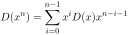
  is a derivation of a ring , then satisfying the following relation
 for all

This functional equation is known as the “ -power property". The study of such mappings were initiated by Bridges and Bergen [1]. In 1984, they proved that such type of map exhibiting power property is a derivation on , when is a prime ring with identity and when
 or is zero. In the year 2007, Lanski [4] generalized this result from derivations to generalized derivations in semiprime rings. Recently, author together with Dar [2] introduced the notion of “-power *- property" and studied these results in the setting of rings with involution. Precisely, an analogous result for Jordan *-derivations on prime rings with involution was obtained by author together with Dar [2] (see also [3] for more related results).
In this talk, we will discuss the recent progress made on the topic and related areas. Precisely, we describe the structure of maps involved in the functional equation
 . Finally, we conclude our talk with some recent open problems.
Bibliography.
 in a ring. Proc. Amer. Math. Soc., 90, 25–29.
 -derivations of prime rings, Comm. Algebra, 49(4), 1422-1430.
power -property in -rings with applications, Comm. Algebra, 49(9), 3961-3968.
Power Maps in Rings, Comm. Algebra, 35(11), 3660-3672.
-derivations of prime rings, Comm. Algebra, 49(4), 1422-1430.
power -property in -rings with applications, Comm. Algebra, 49(9), 3961-3968.
Power Maps in Rings, Comm. Algebra, 35(11), 3660-3672.
ALIGARH MUSLIM UNIVERSITY
ALIGARH, UTTAR PRADESH, INDIA
shakir.ali.mm at amu.ac.in
Graph magma algebras arise from a very concrete idea: a directed graph is used to prescribe the multiplication of a basis. In this talk, we discuss how such elementary combinatorial data can lead to rich ring-theoretic and representation-theoretic structures.
We focus on two natural graph-based multiplication rules. In the one-value case, a product either returns the first factor or becomes zero. Associativity imposes strong restrictions on the graph, leading to a normal form for associative one-value graph magma algebras. We explain how the Jacobson radical, socles, projective modules, and certain Kasch-type properties can be read directly from this graph-theoretic description. In the semiperfect case, the corresponding Gabriel quiver has a star-shaped form, reflecting the role of nilpotent and idempotent vertices.
We then turn to the two-value case, where every product chooses one of its two factors. Here associativity leads to a block-line decomposition of the graph into complete and null blocks. By adjoining the identity as a vertex, we obtain graph monoids and their monoid algebras. The resulting algebras are controlled by a signed invariant, the block signature, which determines the projective structure, direct product decompositions, and the Gabriel quiver. In particular, these algebras admit radical-square-zero presentations by block-line quivers.
Overall, the talk illustrates how the ring structure of graph magma algebras is governed by simple but surprisingly rigid combinatorial patterns.
This is a joint work with G lhan Misra Bayer and B lent Sara . This study was supported by The Scientific and Technological Research Council of T rkiye (T B TAK) under the Grant Number 122F105.
HACETTEPE UNIVERSITY
ANKARA, T RKIYE
paydogdu at hacettepe.edu.tr
 matrix of rank
  , where , , and
  are positive integers. The construction is based on the concept of double-reflected matrices over a finite commutative ring with unity and the finite field
 .
.
matrix with rank . Moreover, this approach enables the determination of a lower bound for the distance before completing the whole calculation process.
Theorem.
Let  be a
matrix over the ring with
be a
matrix over the ring with  . Then, the reversible code
 has
has
![$[2n, k, d']$](img70.svg) parameters, where
parameters, where  ,
,
 is a
is a ![$[n,k,d]$](img73.svg) -code and
-code and  is the double-reflected matrix of
 ![$M=_{ij}]$](img75.svg) , that is,
, that is,
![$M''=_{ij}]$](img76.svg) with
with
 .
.
Theorem.
Let
 and
and
 be two -code over
. Then, the code
be two -code over
. Then, the code
 is a
-linear code over
with , and
is a
-linear code over
with , and  corresponds to a reversible DNA code. Here,
  is the DNA corresponding map used in [5].
matrix over the ring , the concatenated code
 is reversible and has parameters
with a guaranteed lower bound
is reversible and has parameters
with a guaranteed lower bound
 , where are the parameters of
.
Second, over
, the Frobenius-Hadamard lift preserves the base parameters, and the DNA correspondence maps
, where are the parameters of
.
Second, over
, the Frobenius-Hadamard lift preserves the base parameters, and the DNA correspondence maps
 to a reversible DNA code, in the spirit of lifted polynomial constructions for DNA coding [5,6].
The examples provided in this work further show that AMDS/MDS instances arise naturally and that a non-reversible linear code may still correspond to a reversible DNA code under . Computational verification and parameter optimization can be efficiently carried out using computer algebra systems such as Magma [4].
to a reversible DNA code, in the spirit of lifted polynomial constructions for DNA coding [5,6].
The examples provided in this work further show that AMDS/MDS instances arise naturally and that a non-reversible linear code may still correspond to a reversible DNA code under . Computational verification and parameter optimization can be efficiently carried out using computer algebra systems such as Magma [4].
Bibliography.
 , constant GC-content and a reverse-complement constraint,” Discrete Math., vol. 312, no. 5, pp. 1062–1075, 2012.
 and their applications to DNA codes,” Filomat, vol. 27, no. 3, pp. 461–468, 2013.
DEPARTMENT OF MATHEMATICS, ALIGARH MUSLIM UNIVERSITY
ALIGARH, UTTAR PRADESH, INDIA
mohdazeem9211 at gmail.com
Understanding the Wedderburn decomposition of rational group algebras and the structure of their simple components is a classical problem connecting group theory, ring theory, and number theory. In this talk, we present a new framework based on generalized strong Shoda pairs that yields explicit crossed product descriptions of simple components. This approach leads to constructive versions of the Brauer–Witt theorem and provides effective tools for computing Schur indices. Applications to large classes of monomial groups and explicit examples will be discussed
PANJAB UNIVERSITY, CHANDIGARH, INDIA
CHANDIGARH, UNION TERRITORY, INDIA
gkbakshi at pu.ac.in
An answer to an old question is given: What is Galois Theory for arbitrary finite field extensions? For purely inseparable field extensions, Jacobson (1937, 1944) established the exponent-one case, with further generalizations to modular extensions due to Sweedler (1968) and Gerstenhaber–Zaromp (1970).
UNIVERSITY OF SHEFFIELD, UK
SHEFFIELD, UNITED KINGDOM
v.bavula at sheffield.ac.uk
Abstract Let
 be a quasi-Cartan pair of algebras. Then there exists a unique discrete groupoid twist
 whose twisted Steinberg algebra is isomorphic to in a way that preserves . In this talk, we show there is a lattice isomorphism between wide open subgroupoids of and subalgebras
  such that
 and
and
 is a quasi-Cartan pair. We also characterize which algebraic diagonal/algebraic Cartan/quasi-Cartan pairs have the property that every subalgebra C with
has
a diagonal/Cartan/quasi-Cartan pair. In the diagonal case, when the coefficient ring is a field, it is all of them. Beyond that, only pairs that are close to being diagonal have this property. This work is joint with A. Fuller and L. Orloff-Clark.
is a quasi-Cartan pair. We also characterize which algebraic diagonal/algebraic Cartan/quasi-Cartan pairs have the property that every subalgebra C with
has
a diagonal/Cartan/quasi-Cartan pair. In the diagonal case, when the coefficient ring is a field, it is all of them. Beyond that, only pairs that are close to being diagonal have this property. This work is joint with A. Fuller and L. Orloff-Clark.
COLUMBUS, OH
jbrown10 at udayton.edu
Nicholson introduced the notion of clean rings in 1977. During the period, many authors studied these notions and also generalized these notions in many ways. Y. Ye introduced the notion of semiclean rings by using periodic elements in place of idempotents in the definition of clean elements. An element of a ring is called a semiclean element if it is sum of a unit and a periodic element of the ring. A ring is called a semiclean ring if every element of the ring is semiclean. Here, we plan to discuss some recent developments in these notions.
DEPARTMENT OF MATHEMATICS, UNIVERSITY OF ALLAHABAD
PRAYAGRAJ, UTTAR PRADESH, INDIA
akchaturvedi.math at gmail.com
Finding where the zeros of a polynomial live is a fundamental problem, but it becomes significantly trickier when the polynomials are over non-commutative quaternions. Existing bounds are often limited to specific cases, like those using standard Fibonacci or Leonardo numbers. In this talk, I'll introduce a powerful new framework that uses the extended (k,t)-Fibonacci sequence to create a highly flexible "shell" that guarantees to contain all zeros of a given quaternion polynomial. I will show how a single theorem, by simply tuning the parameters k and t, can reproduce and significantly sharpen previously known bounds based on k-Fibonacci, k-Leonardo, Pell, and Lucas numbers. You'll leave with a clear view of how this unified approach not only simplifies the field but also provides demonstrably tighter estimates for polynomial zero localization.
DEPARTMENT OF MATHEMATICS AND NEWTOUCH CENTER FOR MATHEMATICS, SHANGHAI UNIVERSITY
BOASHAN, SHANGHAI, PEOPLE'S REPUBLIC OF CHINA
ishfaq619 at gmail.com
This paper investigates centrally (quasi-)morphic modules as a natural generalization of centrally morphic rings. An -module is defined as centrally quasi-morphic if, for every endomorphism
 End
End , there exist central elements
 End such that
 and
Im
and
Im . Furthermore, is termed centrally morphic if
  satisfies the given conditions. A ring is said to be right (left) centrally (quasi-)morphic if
  (
( ) is centrally (quasi-)morphic. We prove that is right centrally morphic if and only if it is right centrally quasi-morphic. Furthermore, modules whose endomorphism rings are regular (resp., unit-regular or strongly regular) are termed endoregular (resp. unit-endoregular or strongly endoregular). While it is known that every endoregular module is quasi-morphic and every unit-endoregular module is morphic, we show that every st
rongly endoregular module is centrally morphic. Finally, these relationships are summarized in a diagram, and we provide illustrative examples demonstrating that these implications are not generally reversible.
) is centrally (quasi-)morphic. We prove that is right centrally morphic if and only if it is right centrally quasi-morphic. Furthermore, modules whose endomorphism rings are regular (resp., unit-regular or strongly regular) are termed endoregular (resp. unit-endoregular or strongly endoregular). While it is known that every endoregular module is quasi-morphic and every unit-endoregular module is morphic, we show that every st
rongly endoregular module is centrally morphic. Finally, these relationships are summarized in a diagram, and we provide illustrative examples demonstrating that these implications are not generally reversible.

We demonstrate that for image-projective modules, the notions of centrally morphic and centrally quasi-morphic coincide, and we further establish that every centrally quasi-morphic module is abelian. Regarding semisimple modules, we prove that a module  is centrally (quasi-)morphic if and only if it is strongly endoregular, which is equivalent to the condition that every homogeneous component of has length 1. Additionally, we provide a complete characterization of centrally (quasi-)morphic modules that are direct sums of cyclic modules over principal ideal domains. Finally, we establish various structural properties of modules satisfying these conditions.
PERSIAN GULF UNIVERSITY
BOUSHEHR, IRAN
najmeh.dehghany at gmail.com
Isometries provide a rigorous basis for classifying skew constacyclic codes, as they preserve the Hamming distance and the essential algebraic structure. However, the current isometry theory for skew constacyclic codes is largely confined to a fixed field automorphism, despite the fact that codes defined by different automorphisms can be isometric. This leaves a structural gap in the classification of skew constacyclic codes. In this talk, we close this gap by developing a more general isometry
framework that allows the automorphism parameter to vary. We define isometries between skew
 - and skew
-constacyclic codes over the finite field
- and skew
-constacyclic codes over the finite field
 with
with  elements, where
  is a prime and m is a positive integer, via Hamming-distance-preserving
-module homomorphisms between the associated quotient modules. Here, each
is a prime and m is a positive integer, via Hamming-distance-preserving
-module homomorphisms between the associated quotient modules. Here, each  is an automorphism of
, and each
is an automorphism of
, and each  is a nonzero element of
. We establish necessary and sufficient conditions for the existence of such isometries and classify the resulting equivalence relation on the full parameter space by giving a complete set of representatives. As immediate consequences, we obtain necessary and sufficient conditions describing when skew constacyclic codes collapse to major subclasses, including constacyclic, skew cyclic, and cyclic codes. Examples are included to demonstrate the effectiveness of the theory.
is a nonzero element of
. We establish necessary and sufficient conditions for the existence of such isometries and classify the resulting equivalence relation on the full parameter space by giving a complete set of representatives. As immediate consequences, we obtain necessary and sufficient conditions describing when skew constacyclic codes collapse to major subclasses, including constacyclic, skew cyclic, and cyclic codes. Examples are included to demonstrate the effectiveness of the theory.
Joint work with Nhan T.V. Nguyen and Nguyen K. Tung.
KENT STATE UNIVERSITY
WARREN, OHIO
hdinh at kent.edu
In this talk, we focus on the algebras  of matrices over a commutative infinite-dimensional
  -algebra , where is an arbitrary field. We extend the study of amenability and congeniality of bases in a natural non-commutative direction. Faced with an abundance of bases for these algebras exhibiting mixed levels of complexity, we begin our study by focusing on modular bases. In characterizing amenability and congeniality in this context, we uncover a new relation, which we call amenable congeniality. This relation becomes a central ingredient in characterizing both the amenability of modular bases and congeniality among modular bases. Amenable congeniality also appears to be worthy of consideration in its own right, and we therefore discuss it extensively in this talk.
OHIO UNIVERSITY
ATHENS, OH
f.ebrahim at ohio.edu

We discuss a generalization of classical Reed-Muller codes using representations of quivers over
, the field with one element. In particular given a quiver  , an
representation
, an
representation  of , and a natural number
  , we construct the binary code
RM
, we construct the binary code
RM . In the case that is a semisimple representation with simple components, we recover the usual Reed-Muller code
RM
. In the case that is a semisimple representation with simple components, we recover the usual Reed-Muller code
RM . In this talk, we will give an overview of representation theory over
and detail the construction of the codes
RM. We will give some preliminary results on the minimum distance and block length for equi-oriented type A quivers and discuss directions for future research. This is joint work with Alex Sistko.
. In this talk, we will give an overview of representation theory over
and detail the construction of the codes
RM. We will give some preliminary results on the minimum distance and block length for equi-oriented type A quivers and discuss directions for future research. This is joint work with Alex Sistko.
MILWAUKEE SCHOOL OF ENGINEERING
MILWAUKEE, WISCONSIN
jeremyedison92 at gmail.com
A well-known result due to Chase establishes that a ring is right coherent if and only if every direct product of projective left -modules is flat. On the other hand, flat modules are known to form the left-hand class of a complete cotorsion pair, and the modules in the right-hand class of such a cotorsion pair are known as cotorsion modules. This flat-cotorsion pair was an essential tool in the proof of the Flat Cover Conjecture see [1].
In this talk, we consider a dual situation to Chase's theorem, i.e. we characterize the class of rings for which every direct sum of injective left -modules is a cotorsion module. We call these rings left weakly  -cotorsion rings. Among other interesting properties, these rings arise naturally in the study of the (lack of) balance of the right derived functors of the
 functor associated with flat resolutions.
Noetherian and perfect rings are trivial examples of left weakly -cotorsion rings, but we present many other nontrivial examples. In fact, we consider the more general situation of rings for which every direct sum of injective modules has cotorsion dimension  , which we call left weakly --cotorsion rings. A major breakthrough in the study of these rings is based on an extension of a result see [2, Theorem 3.3] due to aroch and tov ek concerning the first-order-theoretic nature of -cotorsionness.
This talk is part of joint work with Manuel Cort s-Izurdiaga and Sergio Estrada (see [3]).
[1] Bican, L., El Bashir, R., Enochs, E.E., All modules have flat covers. In: Bulletin of the London Mathematical Society 33.4 (2001), pp. 385-390. DOI: 10.1017/S0024609301008104
[2] aroch, J., ov ek, J., Singular compactness and definability for -cotorsion and Gorenstein modules. In: Selecta Mathematica 26.23 (2020), Article 23. DOI: 10.1007/s00029-020-0543-2
[3] Cort s-Izurdiaga, M., Estrada, S., Fresneda, J.M., Weakly Sigma-cotorsion rings. arXiv:2602.11303
UNIVERSITY OF MURCIA
MURCIA, SPAIN
josemanuel.fresnedae at um.es
The Serre–Swan correspondence provides a connection between algebra and geometry. It identifies vector bundles with finitely generated projective modules: in algebraic geometry, locally free sheaves of finite rank on an affine scheme correspond to finitely generated projective modules over its coordinate ring. In topology, vector bundles over a compact Hausdorff space correspond to finitely generated projective modules over  . In this talk, we will give an algebraic analogue for Swan's extension lemma which needed to prove the Serre-Swan correspondence.
TEXAS TECH UNIVERSITY
LUBBOCK, TEXAS
gnipun at ttu.edu
Let be a ring with unity. In this paper, we introduce and study the notion of quasipolarity along an element in rings, which extends the classical concept of quasipolar elements and is closely connected to generalized Drazin invertibility. We present several equivalent characterizations of quasipolarity along an element and establish the uniqueness of the associated quasi-spectral idempotent. Furthermore, we introduce the concept of quasi-invertibility along an element and prove that it is equivalent to quasipolarity along an element. We also show that an element  is quasipolar along an element if and only if
  is generalized Drazin invertible. In addition, we investigate the dual notion of quasipolarity along an element and prove that it coincides with quasipolarity along an element. Finally, we examine its relationships with
  -quasipolarity and generalized inverses, together with its invariance under similarity transformations and several consequences
of Cline's formula.
-quasipolarity and generalized inverses, together with its invariance under similarity transformations and several consequences
of Cline's formula.
ANKARA UNIVERSITY
ANKARA, ELMADA , T RKIYE
javidgulizade2021 at gmail.com
javidguluzada at ankara.edu.tr
Entangled polynomials ![$k^m[x]$](img130.svg) were first described by L pez and Pallone for a field , then extended to general entangled polynomials
were first described by L pez and Pallone for a field , then extended to general entangled polynomials ![$R^m[x]$](img131.svg) by Lee, Leroy, and L pez, as subrings of the set of row and finite matrices
by Lee, Leroy, and L pez, as subrings of the set of row and finite matrices  . These were then found to be isomorphic to certain subrings of
 ![$M_m(R[x])$](img133.svg) and the skew polynomial ring
and the skew polynomial ring
![$(R^m)[t;\pi]$](img134.svg) , where
, where  is a cyclic automorphism of
  . We extend these findings to the ring of formal Laurent series
  and construct the ring of entangled Laurent series
  .
.
OHIO UNIVERSITY
ATHENS, OHIO
ch829222 at ohio.edu
Let
 be a generalized quaternion ring over an arbitrary unital ring
, and let
be a generalized quaternion ring over an arbitrary unital ring
, and let
 denote its supercenter.
In this paper, we investigate additive maps and derivations on generalized quaternion rings with a particular focus on supercentralizing behavior. We characterize the structure of supercentralizing additive maps on
denote its supercenter.
In this paper, we investigate additive maps and derivations on generalized quaternion rings with a particular focus on supercentralizing behavior. We characterize the structure of supercentralizing additive maps on
 and show that every such map is proper. Furthermore, we study supercentralizing derivations on
and prove that every supercentralizing derivation is identically zero. These results contribute to a better understanding of structure-preserving mappings on quaternion-type rings and extend previous results in the literature.
and show that every such map is proper. Furthermore, we study supercentralizing derivations on
and prove that every supercentralizing derivation is identically zero. These results contribute to a better understanding of structure-preserving mappings on quaternion-type rings and extend previous results in the literature.
DEPARTMENT OF MATHEMATICS AND STATISTICS, SHO.C., ISLAMIC AZAD UNIVERSITY, SHOUSHTAR, IRAN
AHVAZ, KHOZESTAN, IRAN
heidaryzadehleila at yahoo.com
Intermediate rings in ring extensions have been always a subject of study from different
aspects. We are interested in this research in extensions of integral domains with sets of
intermediate rings satisfying some finiteness conditions. We establish in this work a
process that provides the list of intermediate rings in the general setting of extensions
 of integral domains with only finitely many intermediate rings with integrally closed in
  .
The main tool of this work: A family of polynomials that are useful in determining and
computing the number of intermediate rings.
.
The main tool of this work: A family of polynomials that are useful in determining and
computing the number of intermediate rings.
UNIVERSITY OF SHARJAH
SHARJAH, UNITED ARAB EMIRATES
ajaballah at sharjah.ac.ae
 -basic graded ideals
In this talk, the Leavitt path algebra is constructed over a commutative ring . It is stated that the quotient of the Leavitt path algebra on a row-finite graph by an arbitrary (basic or non-basic) graded ideal is isomorphic to a direct sum of Leavitt path algebras over suitable graphs. A graded ideal function  on the extended set of vertices, is defined as a tool to obtain the result.
Furthermore, the quotient of a Leavitt path algebra of an arbitrary graph by an -basic graded ideal is isomorphic to the Leavitt path algebra on a suitable graph over the quotient ring
on the extended set of vertices, is defined as a tool to obtain the result.
Furthermore, the quotient of a Leavitt path algebra of an arbitrary graph by an -basic graded ideal is isomorphic to the Leavitt path algebra on a suitable graph over the quotient ring  . Examples are given to illustrate both results.
ZYE IN UNIVERSITY
STANBUL, T RKIYE
muge.er at ozyegin.edu.tr
To know whether a monic irreducible polynomial is monogenic or not is one of the important problems in algebraic number theory. In an attempt to answer this problem for certain family of polynomials, L. Jones in [Bull. Aust. Math. Soc. 100 (2019), 239-244] conjectured that if
 and is a prime number, then the polynomial
![$x^n+A(Bx+1)^m\in\mathbb{Z}[x]$](img146.svg) with
with  and
and
 is monogenic if and only if
 is square-free. In this talk using Dedekind Criterion and classical results from algebraic number theory, we will see that this conjecture is true.
SHANGHAI UNIVERSITY
SHANGHAI, CHINA
sumandhunay at gmail.com
Abstract: Let be a ring with an involution denoted by , and let  be a prime ideal of . An additive mapping
 is called a derivation of if it satisfies the condition
 for all
. A generalized derivation of is an additive mapping
for all
. A generalized derivation of is an additive mapping
 such that
 for all
. This paper explores the structure of the quotient ring
for all
. This paper explores the structure of the quotient ring  in relation to the action of generalized derivations on the prime ideal of . In particular, we investigate the relationship between the commutativity of this class of rings and the generalized derivations that satisfy various algebraic identities involving prime ideals.
Keywords: Derivation, generalized derivation, involution, prime ideal, quotient ring.
ALIGARH MUSLIM UNIVERSITY
ALIGARH, UTTAR PRADESH, INDIA
salahuddinkhan50 at gmail.com
Let
 be a family of algebraic number fields, where
 is a root of the th exponential Taylor polynomial

In this lecture, we shall give a formula for the exact power of any prime dividing the discriminant of  in terms of the -adic expansion of . We shall also describe an explicit -integral basis of for each prime . These -integral bases lead naturally to the construction of an integral basis of .
IISER MOHALI
SAS NAGAR, PUNJAB
INDIA
skhanduja at iisermohali.ac.in
The aim of this presentation is to develop an analytically tractable Riccati-based framework for TIDLQ problems that preserves the essential structural properties of classical linear quadratic control theory. To this end, we introduce a novel formulation that replaces the traditional non-symmetric Riccati equation derived in open-loop setting with a generalized Riccati system exhibiting an intrinsic symmetric structure. The proposed ansatz is based on a refined variational analysis of the original time-inconsistent control problem. By performing a suitable decoupling technique of the value function, we derive a system of coupled matrix equations governing the equilibrium behavior. These relations are then embedded into a generalized Riccati framework that restores symmetry and positivity properties without imposing restrictive assumptions on the underlying problem data.Withing this symmetric Riccati setting, we establish the local well-posedness of the resulting generalized Riccati e quation. The analysis relies on a contraction mapping argument, allowing the application of Banach's fixed point theorem. As a direct consequence, we prove the local existence and uniqueness of solutions to the symmetric Riccati system. Moreover, by the established equivalence between the original TIDLQ problem and equilibrium Riccati equation, we deduce the local existence and uniqueness of a linear equilibrium open-loop control.
UNIVERSITY OF BORDJ BOU ARRERIDJ
EL EULMA, SETIF, ALGERIA
kheireddinerami.djoudi at univ-bba.dz
Hilbert's Nullstellensatz states that a quotient of the algebra of polynomial functions on an algebraic variety over an algebraically closed field is the algebra of polynomial functions on a (sub)variety if and only if its radical is trivial. A noncommutative analogue is: "A quotient of a Leavitt path algebra over an algebraically closed field is isomorphic to a Leavitt path algebra if and only if its radical is trivial (Ko - zaydin)". This suggests that a Leavitt path algebra behaves like a noncommutative algebra of polynomial functions on a directed graph. (Based on research partially supported by the T B TAK grant 122F414.)
GEBZE TECHNICAL UNIVERSITY
GEBZE /KOCAELI, T RKIYE
ozgayten at gmail.com
The concept of the non-semi-essential ideal graph of a lattice L is introduced. In this graph, the vertex set consists of all nonzero non-semi-essential ideals of L, and two vertices are adjacent if their join is a non-semi-essential ideal of L. The relationship between the algebraic properties of L and the graph-theoretic properties of its associated graph is investigated.
DR. VISHWANATH KARAD MIT-WORLD PEACE UNIVERSITY
PUNE, MAHARASHTRA, INDIA
pratibha.kshirsagar at mitwpu.edu.in
We introduce the notion of
 -reflexive rings, which lies strictly between the classes of central reflexive rings and -reflexive rings. In support, we give several examples and counterexamples. We find that the notions of reflexive, central reflexive,
-reflexive, and -reflexive rings are equivalent for the class of -semisimple rings. We also show that the notions of
-reflexive and central reflexive rings are equivalent for the class of rings with no nil ideals.
-reflexive rings, which lies strictly between the classes of central reflexive rings and -reflexive rings. In support, we give several examples and counterexamples. We find that the notions of reflexive, central reflexive,
-reflexive, and -reflexive rings are equivalent for the class of -semisimple rings. We also show that the notions of
-reflexive and central reflexive rings are equivalent for the class of rings with no nil ideals.
We prove that a ring is
-reflexive if and only if, for every  ,
,

 denotes the hypercenter of . We also give several characterizations of
-reflexive rings with the help of their extension rings. Finally, we discuss some of their basic properties and their relationship with the class of Armendariz rings.
denotes the hypercenter of . We also give several characterizations of
-reflexive rings with the help of their extension rings. Finally, we discuss some of their basic properties and their relationship with the class of Armendariz rings.
DEPARTMENT OF MATHEMATICS, FEROZE GANDHI COLLEGE
RAEBARELI , UTTAR PRADESH, INDIA
nirbhayk2897 at gmail.com
In present talk we focus on some generalized sequence spaces under gradual norm defined by ideals. We present some of their topological properties in the framework of gradual norm.
CHANDIGARH UNIVERSITY
MOHALI , PUNJAB, INDIA
kaushikvjy at gmail.com
Let be a field of characteristic  ,
,  the Witt group of nonsingular quadratic forms over , and
  the Witt ring of symmetric bilinear forms over . For any integer
  , let
, let  denote the subgroup
 of , where
  is the -th power of the fundamental ideal
  of (we take
 ). Any quadratic form
 is Witt equivalent to a sum of forms similar to -fold Pfister forms. The -Pfister number of
  , denoted by
 , is the least number of forms similar to -fold Pfister forms needed to express up to Witt equivalence. Our aim in this talk is to discuss the case
  by giving a formula that bounds
 for any . The case where is of dimension
  will be detailed. (This talk is based on joint work with Trisha Ma ti).
ARTOIS UNIVERSITY
LENS, FRANCE
ahmed.laghribi at univ-artois.fr
In 1945, Nathan Jacobson [2] introduced the notion of primitive rings and established a fundamental structure theorem for them, analogous to the classical Wedderburn–Artin theorem for semisimple Artinian rings. A key ingredient in the study of primitive rings is the existence of a faithful simple module.
More recently, Lee, Roman, and Zhang [3] introduced the broader class of rudimentary rings, which properly contains the class of primitive rings. A ring is called right rudimentary if it admits a faithful right -module whose endomorphism ring
 is a division ring. Equivalently, admits a faithful indecomposable endoregular right module.
Structural matrix rings form an important class of subrings of full matrix rings. They are determined by a preorder on the index set and were systematically studied by van Wyk [4] beginning in 1988. Earlier, Clark [1] showed that matrix-unit semigroups naturally give rise to semigroup algebras that can be realized as matrix rings.
In this talk, I will show that structural matrix rings coincide with the matrix rings arising from matrix-unit semigroups. I will then present a characterization of rudimentary structural matrix rings. Finally, I will discuss enumeration results, including counts of structural matrix rings, rudimentary structural matrix rings, and their isomorphism classes.
This is joint work with Sangmin Chun, Mauricio Medina-B rcenas, and Cosmin S. Roman.
Bibliography.
THE OHIO STATE UNIVERSITY/CHUNGNAM NATIONAL UNIVERSITY
COLUMBUS, OH
lgy999 at cnu.ac.kr
Inspired by the product formula that appears while evaluating polynomials from
![$R=t ; \sigma, \delta]$](img180.svg) (
(  a division ring), M. Aryapoor defined a ring structure on the set of maps from to . We first remark that considering the polynomials from
![$K\left[t_1 ; \sigma_1, \delta_1\right] \ldots\left[t_n ; \sigma_n, \delta_n\right]$](img182.svg) , we can similarly define a ring structure on the maps from
, we can similarly define a ring structure on the maps from  to . We then define, more generally, a ring structure on maps from a set
  into a ring when , acts on . This general frame allows us to consider polynomial like functions for various situations taking to be a division ring, a module, a filtered rings,...with various actions. We then recover some features of polynomial maps. In particular, we can define semi-invariant polynomials, compute the inverse of these maps, and also get basic algebraic geometry correspondence in this general frame. The sets of zeros of the functions can also be analyzed in the way it is done
for the case of polynomials.
into a ring when , acts on . This general frame allows us to consider polynomial like functions for various situations taking to be a division ring, a module, a filtered rings,...with various actions. We then recover some features of polynomial maps. In particular, we can define semi-invariant polynomials, compute the inverse of these maps, and also get basic algebraic geometry correspondence in this general frame. The sets of zeros of the functions can also be analyzed in the way it is done
for the case of polynomials.
This is a joint work with Huda Merdach.
UNIVERIT D'ARTOIS
LENS, HAUTS DE FRANCE, FRANCE
leroyandre7555 at gmail.com
A ring R is called almost strongly regular (ASR) if for each  ; either or
  is strongly regular. The class of almost strongly regular rings lies properly between the
class of strongly regular rings and the class of strongly clean rings. In this talk, we discuss basic properties and
the structure of almost strongly regular rings, especially for (formal triangular) matrix rings and group rings.
is strongly regular. The class of almost strongly regular rings lies properly between the
class of strongly regular rings and the class of strongly clean rings. In this talk, we discuss basic properties and
the structure of almost strongly regular rings, especially for (formal triangular) matrix rings and group rings.
BROCK UNIVERSITY
ST. CATHARINES, ON, CANADA
yli at brocku.ca
![$\sigma[M]$](img9.svg)
In 1982 John Beachy gave a general definition of rings with finite reduced rank extending that of Goldie for Noetherian rings. In this talk I will present how this notion can be taken further to categories where is an -module.
UNIVERSIDAD AUT NOMA METROPOLITANA
MEXICO CITY, M XICO
mmedina at xanum.uam.mx
It is well-known that the ideals of a ring form a multiplicative lattice, or quantale. Other types of subobjects of a ring, such as subgroups and submonoids, likewise form quantales, but have received much less attention. We discuss the additive submonoid quantale of an arbitrary ring, with particular focus on the question of which properties of the ring can be recovered from it. We show that this quantale, unlike the ideal quantale, captures significant information about the cardinality, characteristic, and center of the ring. Certain rings, such as non-prime finite fields, torsion-free rings, and those with characteristic 2, are completely determined by their submonoid quantales.
UNIVERSITY OF COLORADO
COLORADO SPRINGS, CO
zmesyan at uccs.edu
We study four purity-based generalizations of the classical conditions  and
and  for modules,
We defined the following notions on :
for modules,
We defined the following notions on :
 | Purely (or
 ): if a submodule of is isomorphic to a pure submodule of , then is also a pure submodule of . ): if a submodule of is isomorphic to a pure submodule of , then is also a pure submodule of .
|
| Generalized purely
 (or (or
 ): if a submodule of is isomorphic to a direct summand of , then is a pure submodule of . (These modules were called purely in literature). ): if a submodule of is isomorphic to a direct summand of , then is a pure submodule of . (These modules were called purely in literature).
|
| Purely (or
 ): if ): if  and and  are pure submodules of with are pure submodules of with
 , then , then
 is a pure submodule of . is a pure submodule of .
|
| Generalized purely
 (or (or
 ): if and are direct summands of with
, then
is a pure submodule of . ): if and are direct summands of with
, then
is a pure submodule of .
|
| We call purely extending modules, in the sense of J. Clark,
 modules. modules.
|
is called purely continuous  or p.continuous just for short
 if has both
and
if has both
and
 , and purely quasi-continuous or p.quasi-continuous if it has
and
, and purely quasi-continuous or p.quasi-continuous if it has
and
 . Moreover, we call generalized purely continuous or g.p.continuous if it has
and
and it is called generalized purely quasi-continuous or g.p.quasi-continuous whenever it has
and
.
Our main result characterizes von Neumann regular rings as precisely those over which every (finitely generated) module satisfies any of these properties. In contrast, we show that rings over which every (finitely generated) module has the or property are exactly the semisimple Artinian rings. We also characterize rings whose finitely cogenerated modules are or , and we investigate when projective modules satisfy these purity conditions. Several illustrative examples are provided.
. Moreover, we call generalized purely continuous or g.p.continuous if it has
and
and it is called generalized purely quasi-continuous or g.p.quasi-continuous whenever it has
and
.
Our main result characterizes von Neumann regular rings as precisely those over which every (finitely generated) module satisfies any of these properties. In contrast, we show that rings over which every (finitely generated) module has the or property are exactly the semisimple Artinian rings. We also characterize rings whose finitely cogenerated modules are or , and we investigate when projective modules satisfy these purity conditions. Several illustrative examples are provided.
RAZI UNIVERSITY
KERMANSHAH, IRAN
rasol.moradi at razi.ac.ir
An algebraic framework to study infinite sums is proposed, complementing and augmenting the usual topological tools. The framework subsumes numerous examples in the literature. It is developed using varied examples, with a particular emphasis on infinitizing the usual group and ring axioms. Comparing these examples reveals that a few key algebraic properties play a crucial role in the behaviors of different forms of infinite summation. Special attention is given to associativity, which is particularly difficult to properly infinitize. In that context, there is an important technique called the Eilenberg-Mazur swindle that is studied and greatly generalized.
BRIGHAM YOUNG UNIVERSITY
PROVO, UT
pace at math.byu.edu
The Prime Number Theorem, states that the number of primes less than or equal to x which we will denoted as π(x) is asymptotic equivalent to x/log(x). This proof has two elements: showing that the Riemann zeta function has no zeros on Re(s) = 1 and deducing the Prime Number Theorem from this.
Ohio UNIVERSITY
ATHENS, OH
dn751620 at ohio.edu
This study focuses on the Mitsch order on modules and investigates its basic properties using endomorphism rings. Just like in semigroups and rings, we show that the Mitsch order is also a partial order on modules. We also compare the Mitsch order with several other orders on modules, such as the Jones, minus, direct sum and space orders. In addition, we discuss the lattice properties of the Mitsch order and examine its compatibility with addition and scalar multiplication.
This is a joint work with T.P. Calci, S. Halicioglu, A. Harmanci, B. Ungor. The speaker is supported by The Scientific and Technological Research Council of T rkiye (T B TAK).
DEPARTMENT OF MATHEMATICS, GRADUATE SCHOOL OF NATURAL AND APPLIED SCIENCES, ANKARA UNIVERSITY
ANKARA, T RKIYE
tpakel at ankara.edu.tr
In this talk we would like to explore the study of ascending/ descending chain condition of variants of module and ring structures and their significance in generalizing classical results. Here we will try to explore several relationship of these modules with injective/ projective modules. Further, we will focus on well-known Hopkins-Levitzki theorem and dual of Hilbert's Basis theorem.
NATIONAL INSTITUTE OF TECHNOLOGY NAGALAND
CHUMOUKEDIMA, NAGALAND, INDIA
manoj at nitnagaland.ac.in
 -Semihyperring
In this paper we have investigated the intra-regular -semihyperring and presented its characterizations while exploring the properties of -hyperideals of . We have also studied the -semihyperring which is both regular and intra-regular and proved some results in this regard. We have investigated converse of some results and provided counter examples as well.
KAVAYITRI BAHINABAI CHAUDHARI NORTH MAHARASHTRA UNIVERSITY, JALGAON
JALGAON, MAHARASHTRA, INDIA
kfpawar at gmail.com
Precover completing domains generalize subprojectivity domains in additive (exact) categories. This is the setting in which study objects having a minimal precover completing domain. We also give some closure properties for precover completing domains and derive applications to finitely accessible categories (in particular, to module categories).
BABE –BOLYAI UNIVERSITY
CLUJ-NAPOCA, ROM NIA
robert.pop at ubbcluj.ro
-Regular Elements and Kaplansky's Question
In Transactions of the American Mathematical Society, Vol. 68 (1950), Kaplansky raised the following question:
It is natural to ask what can be deduced from the assumptionIn this talk, we discuss the subsequent developments and the current status of both the local and global versions of this question.. For example, does this assumption enable one to construct idempotents?
TALWANDI SABO, PUNJAB, INDIA
dimple4goyal at gmail.com
Hyperrings are a generalization of rings in which the sum of two elements consists of a set of elements, rather than a single element. These arise from ordinary rings as quotients by equivalence relations, such as the action of the multiplicative group  of a field on a
-algebra. Although these structures and their modules are quite flexible in their application, they do not form well-behaved categories.
of a field on a
-algebra. Although these structures and their modules are quite flexible in their application, they do not form well-behaved categories.
To repair this situation, we generalize hyperrings to a class of new objects called hoops by omitting the axiom of associativity for addition. The resulting categories of hoops and their modules are very well-behaved, admitting many universal constructions that do not exist for hyperrings. We will discuss how these techniques lead to a “base-free” representation theory of ordinary rings on projective geometries.
UNIVERSITY OF CALIFORNIA, IRVINE
IRVINE, CA
mreyes57 at uci.edu
Let be a prime ring (not necessarily commutative) with involution
of the second kind, center  , and let
 be endomorphisms of . The aim of this article
is to examine the identities
be endomorphisms of . The aim of this article
is to examine the identities
 , where
 and
and
 , with
  denoting the identity map of .
It is shown that each of these identities forces to be
commutative. Moreover, suitable examples justifying the hypotheses are
given.
denoting the identity map of .
It is shown that each of these identities forces to be
commutative. Moreover, suitable examples justifying the hypotheses are
given.
PATEL MEMORIAL NATIONAL COLLEGE
RAJPURA, PUNJAB, INDIA
INDIA
gurninder_rs at pbi.ac.in
In [1], [2], Bican, Kepka, Nemec and Jambor established that every equivalence between categories of modules
 and
and
 induces an isomorphism between
 and
and
 , the corresponding lattices of preradicals. In [3] this result is generalized to the fact that every adjoint pair between two categories of modules induces a Galois connection between the corresponding lattices of preradicals.
In this talk, we step further in the generalization, proving that every adjoint pair
, the corresponding lattices of preradicals. In [3] this result is generalized to the fact that every adjoint pair between two categories of modules induces a Galois connection between the corresponding lattices of preradicals.
In this talk, we step further in the generalization, proving that every adjoint pair  between locally small abelian categories
and
between locally small abelian categories
and
 induces a Galois connection
 between the corresponding collections
 and
and
 of preradicals. As a consequence, we have the result described at the beginning of this introduction in the context of abelian categories: every equivalence induces an order isomorphism between the collections of preradicals. We also study preradicals in the opposite category
 and define the duality assignment
  between both collections of preradicals, which is an order anti-isomorphism that exchanges both operations and both type of preradicals, idempotent and radicals. Finally, we will present a pair of examples, where the lattice of idempotent radicals is described completely. In the first one we consider the category of left
  -modules, where is a pat
h algebra. In the second one, it is considered the category of torsion abelian groups. This is a report of [4], joint work with: Rogelio Fern ndez-Alonso (UAM, Iztapalapa Campus, Mexico), Janeth Maga a (UAM, Azcapotzalco Campus, Mexico), Valente Santiago-Vargas (UNAM, Mexico)
-modules, where is a pat
h algebra. In the second one, it is considered the category of torsion abelian groups. This is a report of [4], joint work with: Rogelio Fern ndez-Alonso (UAM, Iztapalapa Campus, Mexico), Janeth Maga a (UAM, Azcapotzalco Campus, Mexico), Valente Santiago-Vargas (UNAM, Mexico)
Keywords: Galois connections, adjoint pairs, preradicals, lattices
References
UNIVERSIDAD AUT NOMA METROPOLITANA (UAM)
MEXICO CITY, CDMX, M XICO
marlisha at xanum.uam.mx
This paper introduces and systematically investigates the class of weakly
 -projective modules within the framework of QTAG-modules. We demonstrate that this new class constitutes a proper generalization of the previously studied
-projective modules. Key results include decomposition theorems and characterizations that establish fundamental connections between weak projectivity, pillared modules, and -layered modules. Furthermore, we extend these findings using ordinal-indexed --summability conditions, proving that a weakly balanced
-projective module which is --summable is precisely a pillared module.
-projective modules within the framework of QTAG-modules. We demonstrate that this new class constitutes a proper generalization of the previously studied
-projective modules. Key results include decomposition theorems and characterizations that establish fundamental connections between weak projectivity, pillared modules, and -layered modules. Furthermore, we extend these findings using ordinal-indexed --summability conditions, proving that a weakly balanced
-projective module which is --summable is precisely a pillared module.
SAUDI ELECTRONIC UNIVERSITY
JEDDAH, MAKKAH, SAUDI ARABIA
f.sikander at seu.edu.sa
The notion of an abelian category is indispensable to modern algebra. Recently, examples of categories whose objects lack traditional algebraic structure, but which retain crucial aspects of abelian categories, have caught the attention of researchers in algebraic geometry, combinatorics, and representation theory. Several competing notions of this phenomenon are known as proto-abelian categories. In this talk, we discuss matroids over idylls as a particular instance of this trend. We show that a proto-abelian structure exists on the category of matroids over a perfect idyll, generalizing known results for matroids. We also show that a similar structure exists on a certain category of sheaves over a tropical toric variety, allowing one to recover their Harder-Narasimhan filtrations from a categorical lens. Time permitting, we also discuss ongoing work to understand representations of quivers in proto-abelian categories. Joint work with Jaiung Jun and Cameron Wright.
SUNY NEW PALTZ
NEW PALTZ, NY
sistkoa at newpaltz.edu
In this paper we initiate the study of quivers carrying quantum Yang–Baxter and Hecke structure, and we apply this framework to study path algebras over quivers whose loop spaces carry RTT relations determined by Hecke -matrices. We show that the quantum matrix algebra
 is isomorphic as a bialgebra to the face algebra over a rose quiver deformed by RTT relations of the
  Hecke -matrix. (This is a joint work with Cody Gilbert)
SAINT LOUIS UNIVERSITY
SAINT LOUIS , MO
ashish.srivastava at slu.edu
Connectivity is an important concept in graph theory, especially in the design of reliable and fault-tolerant networks. The notion of g-extra connectivity describes the ability of a network to tolerate failures by ensuring that, after the removal of certain vertices or edges, every remaining connected component contains at least g + 1 vertices.
This work studies both vertex and edge versions of g-extra connectivity for several corona-type graph products, including the edge corona, neighbourhood corona, subdivision neighbourhood corona, and rooted graph products. A correction to an earlier result on the g-extra edge connectivity of the corona product is also presented. These results help in understanding the robustness of graph products and their applications in modeling reliable networks.
NATIONAL INSTITUTE OF TECHNOLOGY SIKKIM, INDIA
RAVANGLA, NAMCHI, SIKKIM, INDIA
ravi at nitsikkim.ac.in
In this talk, we present two applications of a family of determinant-like maps
 . We show that
  provides a criterion for determining whether a -partition of the complete -uniform hypergraph
  forms a spanning hypertree partition. We also examine the relationship between the map
  and the -equilibrium condition associated with Newton's third law of motion. This is joint work with Steven Lippold and Alin Stancu.
BOWLING GREEN STATE UNIVERSITY
BOWLING GREEN, OHIO
mstaic at bgsu.edu
() modules
The notion of extending modules was generalized to purely extending modules by John Clark in 1998. An -module is said to be purely extending (or
) if every submodule of is essential in a pure submodule. In this paper, we introduce pure analogues of the and properties. Specifically, we define a module to be purely (denoted by
) (resp. generalized purely , denoted by
) if every submodule isomorphic to a pure submodule (resp. direct summand) of is itself pure. Furthermore, we say that satisfies the purely (resp. generalized purely , denoted by
) property if the sum of any two independent pure submodules (resp. direct summands) of is a pure submodule. In addition, we establish that
 , whereas the converse does not hold in general. The following diagram illust
rates these implications and highlights the irreversibility of certain relationships:
, whereas the converse does not hold in general. The following diagram illust
rates these implications and highlights the irreversibility of certain relationships:

Focusing on modules satisfying the
condition, we investigate their general properties and the interrelations among the following classes:
is purely continuous (or p.continuous) if it satisfies both
and
.
is purely quasi-continuous (or p.quasi-continuous) if it satisfies both
and
.
is generalized purely continuous (or g.p.continuous) if it satisfies both
and
.
is generalized purely quasi-continuous (or g.p.quasi-continuous) if it satisfies both
and
.
RAZI UNIVERSITY
IRAN
yasertoloei at yahoo.com
Let be a ring. A right -module is called a simple-direct-injective module if, whenever and  are simple submodules of with
  and a direct summand of , then is a direct summand of . In this talk, firstly we will give some new characterizations of these modules. Secondly, the structure of simple-direct-injective modules over a commutative Dedekind domain will be fully determined. Finally, some relevant counterexamples will be given to show that being simple-direct injective for rings is not left-right symmetric.
HACETTEPE UNIVERSITY
ANKARA T RKIYE
keskin at hacettepe.edu.tr
On this talk we discuss the progress of dualizing the classical theory of prime ideals of a (possibly noncommutative) ring, developing properties of coprime ideals and the coprime spectrum from the lattice-theoretic and preradical perspectives of Bican–Kepka–N mec and Raggi–R os–Wisbauer.
More precisely, for a ring , a two-sided ideal is coprime if
 or
or

![$\displaystyle (I:_R J)=\bigcap\{f^{-1}[J]: f\in\operatorname{End}_R(R),\ I\subseteq\operatorname{Nuc}(f)\}.
$](img230.svg)
Finally, we will see applications to module theory and new characterizations of rings.
IMATE-UNAM
CDMX, M XICO
jesus_vc9 at ciencias.unam.mx
Quasi-cyclic codes form an important class of linear codes that generalize cyclic codes while retaining rich algebraic structure and practical flexibility. In this talk, we introduce a new construction of quasi-cyclic codes arising from entangled polynomial rings. Motivated by recent developments on -nomials and entangled algebraic structures, we consider entangled versions of quotient rings of the form
![$F[x]/\langle x^n-1\rangle$](img231.svg) . Within this framework, suitable left and right ideals naturally produce quasi-cyclic codes; we refer to these codes as shuffle-cyclic codes. The talk will present the main motivation, basic construction, and coding-theoretic significance of this new family, while also pointing toward ongoing work on their algebraic structure, parameters, and potential applications.
. Within this framework, suitable left and right ideals naturally produce quasi-cyclic codes; we refer to these codes as shuffle-cyclic codes. The talk will present the main motivation, basic construction, and coding-theoretic significance of this new family, while also pointing toward ongoing work on their algebraic structure, parameters, and potential applications.
OHIO UNIVERSITY
ATHENS, OHIO
vo at ohio.edu
We review an Embedding Theorem, and present a new Fitting Form Lemma. These results suggest new approaches for handling triangular matrix rings. They are applied to proving results on the strong clean property, the strong 2-sum property, and the Hirano-Tominaga property of triangular matrix rings.
ST.JOHN'S, CANADA
zhou at mun.ca
 for all