


Denote the MOs for a closed-shell system by  . Then the total energy
is
. Then the total energy
is

where 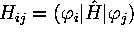 and
and  is the kinetic
energy and nuclear attraction energy operator.
is the kinetic
energy and nuclear attraction energy operator.  and
and  are
coulomb and exchange integrals:
are
coulomb and exchange integrals:

where

Now the symmetry of the MOs is inserted. The MOs,  ,
are re-indexed by irreducible representation (
,
are re-indexed by irreducible representation (  ,
,  ,
,  ),
subspecies (
),
subspecies (  ,
,  , ) and a third index (i, j, )
to number MOs whose other two indices are the same. The indices
, ) and a third index (i, j, )
to number MOs whose other two indices are the same. The indices
 are analogous to the H atom
  indices except that i
always starts at one.
indices except that i
always starts at one.
The expansion of the MOs in terms of basis functions is also put in at this
point. They are symmetry orbitals,  , and are indexed by
irreducible representation, subspecies, and, again, a third index (p, q,
) to number functions whose other two indices are the same. The MO
coefficients are
, and are indexed by
irreducible representation, subspecies, and, again, a third index (p, q,
) to number functions whose other two indices are the same. The MO
coefficients are  and, very importantly, don't depend on
.
and, very importantly, don't depend on
.

The total energy is now
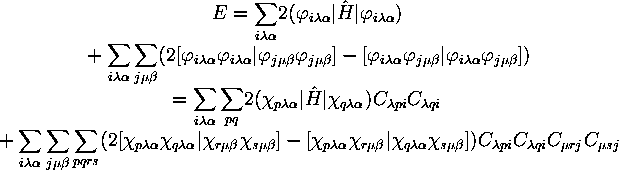
Since the i-type indices only appear in the form  , the energy can be expressed in terms of the density matrix

where  is the dimension of the irreducible representation
and, accordingly,
is the dimension of the irreducible representation
and, accordingly,  is the occupation number of the
  shell.

The number of terms in the summations can be reduced by using the fact that the
density matrix  is symmetric to interchange of p and q.
Thus, each of the pq-type sums in the energy expression may be subdivided
into p>q, p=q, and p<q terms. Then the p<q terms have their p and
q indices interchanged and are combined with the p>q terms. The p=q
terms are then incorporated into the same expression by the use of factors of
the form
is symmetric to interchange of p and q.
Thus, each of the pq-type sums in the energy expression may be subdivided
into p>q, p=q, and p<q terms. Then the p<q terms have their p and
q indices interchanged and are combined with the p>q terms. The p=q
terms are then incorporated into the same expression by the use of factors of
the form  .
.

This is the energy expression in terms of the minimum number of independent integrals. Thus it is convenient to define notation for these (shell-) averaged one-electron, coulomb, exchange, and P integrals:
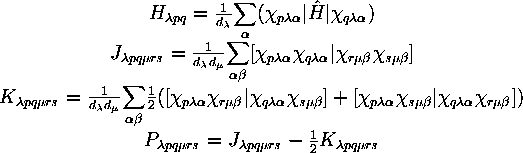
If these integrals are to be evaluated by actually performing the averaging
summations, some simplifications can be used. All the terms in the
 sum are equal, and the coulomb and exchange integrals only
need to be averaged over either or , not both. The expressions
given above, however, have the useful property that, when the summations and
integrations are interchanged, the integrand contains only a totally symmetric
part. This is necessary in one method [13] of computing the integrals
when AO expansions are used.
sum are equal, and the coulomb and exchange integrals only
need to be averaged over either or , not both. The expressions
given above, however, have the useful property that, when the summations and
integrations are interchanged, the integrand contains only a totally symmetric
part. This is necessary in one method [13] of computing the integrals
when AO expansions are used.
For energy expressions it is simpler to write the summations as pq rather
than  with factors. This will be done from this
point on with the understanding that when calculations are actually carried
out, elements will only be computed with , those with
p>q will be doubled, and the energy summations will be done for only.
with factors. This will be done from this
point on with the understanding that when calculations are actually carried
out, elements will only be computed with , those with
p>q will be doubled, and the energy summations will be done for only.
