


The coefficients describing the electron repulsion interactions within and
between open shells must be consistent with the number of electrons involved.
Within a shell of occupation number  there are
 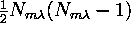 pairs of electrons, and between shells with
occupation numbers and
pairs of electrons, and between shells with
occupation numbers and  there are
  pairs of electrons. Classically, one would expect an electrostatic
integral involving the charge distributions of two orbitals,
pairs of electrons. Classically, one would expect an electrostatic
integral involving the charge distributions of two orbitals,
 , for each pair of electrons. The same result can be
obtained quantum mechanically by expressing the wavefunction in terms of Slater
determinants and noting that integrals of this type can only be obtained in
diagonal determinantal matrix elements, and that they occur there once for each
pair of electrons.
, for each pair of electrons. The same result can be
obtained quantum mechanically by expressing the wavefunction in terms of Slater
determinants and noting that integrals of this type can only be obtained in
diagonal determinantal matrix elements, and that they occur there once for each
pair of electrons.
All of the integrals in averaged coulomb integral summations are of the
classical electrostatic type, while in averaged exchange integral summations
only the intrashell terms with  are of this type. Thus, if the
energy can be expressed in terms of the averaged integrals, the intrashell
coefficients must satisfy
are of this type. Thus, if the
energy can be expressed in terms of the averaged integrals, the intrashell
coefficients must satisfy

or

and the intershell coefficients must satisfy

or

Once a state has been found whose energy can be expressed in terms of the
averaged integrals, then other states with energies of this form can often be
found by a general procedure based on the fact that the two-electron spatial
function  is both totally symmetric and invariant to the interchange of the coordinates
of the two electrons. An -electron wavefunction of the desired
form for the
is both totally symmetric and invariant to the interchange of the coordinates
of the two electrons. An -electron wavefunction of the desired
form for the  shell is multiplied both by this spatial factor and by
a two-electron singlet spin factor, the electrons in both factors being
numbered
shell is multiplied both by this spatial factor and by
a two-electron singlet spin factor, the electrons in both factors being
numbered  ,
,  . Provided that it does not vanish
upon antisymmetrization, the new wavefunction will have the same space and spin
symmetry as the original wavefunction, but will contain two more electrons.
Due to the form of the two-electron factors, the additional electron repulsion
terms can be expressed in terms of the averaged integrals. Series of
wavefunctions related in this manner are said to have the same
seniority [16], which is defined as the lowest value of
for which such a wavefunction exists. The seniority is a useful label when
more than one term of a particular type arises from an electron configuration.
For example, from
. Provided that it does not vanish
upon antisymmetrization, the new wavefunction will have the same space and spin
symmetry as the original wavefunction, but will contain two more electrons.
Due to the form of the two-electron factors, the additional electron repulsion
terms can be expressed in terms of the averaged integrals. Series of
wavefunctions related in this manner are said to have the same
seniority [16], which is defined as the lowest value of
for which such a wavefunction exists. The seniority is a useful label when
more than one term of a particular type arises from an electron configuration.
For example, from  there are two
  wavefunctions, one of seniority 1
and one of seniority 3.
wavefunctions, one of seniority 1
and one of seniority 3.
If is zero or one, there is no electron repulsion energy, so two
series of states can be generated from these very simple starting points. The
first series (case I in Table 1) is a set of totally symmetric singlets with
seniority zero. They start at the empty shell (  ) and end at
the closed shell (
) and end at
the closed shell (  ). The second series (case II in
Table 1), is a set of doublets of
). The second series (case II in
Table 1), is a set of doublets of  symmetry and seniority one. They
start at the particle state (
symmetry and seniority one. They
start at the particle state (  ) and end at the hole state
(
) and end at the hole state
( 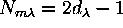 ). The general formulas given for these two cases
in Table 1 have been proven for most cases of interest, but not generally.
Wavefunctions which are general in
). The general formulas given for these two cases
in Table 1 have been proven for most cases of interest, but not generally.
Wavefunctions which are general in  were written down for
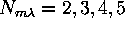 . The resulting energy expressions were fit to quadratic
forms in and were found to satisfy the general relationship
between the energies of corresponding states from shells of and
. The resulting energy expressions were fit to quadratic
forms in and were found to satisfy the general relationship
between the energies of corresponding states from shells of and
 electrons, which in terms of averaged integrals is

Thus the formulas are proven for all when  , and
are probably valid in general.
, and
are probably valid in general.
Other types of states whose energy can be expressed in terms of averaged
integrals are the half-filled shell (  ) with all spins
parallel, and the states obtained by adding or removing an electron
(
) with all spins
parallel, and the states obtained by adding or removing an electron
( 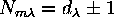 ) from this state. The latter states (case III in
Table 1) have spin
) from this state. The latter states (case III in
Table 1) have spin  ) and the former state (case IV in
Table 1) has spin
) and the former state (case IV in
Table 1) has spin  . These three states are the highest
spin states.
. These three states are the highest
spin states.
It is widely known that the average energy of all the states of a configuration, and therefore the total energy also, have the form of the closed-shell energy, but reduced by a multiplicative constant.


It is also known, but not as widely, that the average and total energies of all
the states of a configuration with a given spin are also expressible in terms
of the averaged integrals, although not in the closed-shell form. Thus if all
the states of a configuration except one, or even all those of a given spin
except one, fall into the four cases treated already, the energy of the
remaining state must be expressible in terms of the averaged integrals also.
There are only a few instances (case V in Tables 2, 3) where this occurs. For
 ,
,  , there are case I and case IV states and,
except in symmetry groups where the principal axis is a fourfold proper or
improper rotation axis, only one other state,
, there are case I and case IV states and,
except in symmetry groups where the principal axis is a fourfold proper or
improper rotation axis, only one other state,  (see
(see 
 in
Table 3). For
in
Table 3). For  in spherical or icosahedral symmetry, and for
 , there are case I and case III states and only one other
state, (see
, there are case I and case III states and only one other
state, (see  ,
, 
 in Table 2). In the same situation except that
 , there are case II and case IV states and only one other state
(see
, there are case II and case IV states and only one other state
(see  in Table 2).
There can be two shells of the same symmetry only if the same coefficients can
serve both as intrashell and intershell coefficients. This requires that the
intrashell coulomb coefficient be zero, which is only possible if it is
half-filled with all spins parallel (case IV). Thus the coupling between
shells must also be of the all-spins-parallel type and the only possibilities
are 
 ,
, 
 , etc. In improved virtual
orbital calculations [17] only the intershell coefficients play a role in
determining the virtual orbitals, so it is possible to proceed whenever they
can be specified correctly.
, etc. In improved virtual
orbital calculations [17] only the intershell coefficients play a role in
determining the virtual orbitals, so it is possible to proceed whenever they
can be specified correctly.
When the open-shell orbital is not degenerate (  ,
), the coefficients are not unique because
,
), the coefficients are not unique because
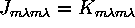 . There is no electron repulsion
so the coefficients need satisfy only
. There is no electron repulsion
so the coefficients need satisfy only

or

The choice 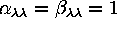 would be
appropriate if it is desired that the virtual orbitals approximate Rydberg
orbitals as closely as possible. If there is more than one open shell of
symmetry, the choice must be
would be
appropriate if it is desired that the virtual orbitals approximate Rydberg
orbitals as closely as possible. If there is more than one open shell of
symmetry, the choice must be  ,
,
 .
.
If the energy of the state of interest cannot be expressed in terms of the
averaged integrals, the only alternative within the present formulation is to
assume that the orbitals in one or more other states are the same, and to
average the energies of these states to obtain the desired form for the energy
expression. This may involve all the states of a given configuration, all of
the states with a particular spin from the configuration, or sometimes a still
smaller number of states. This energy value, when computed, is useful when the
splittings are small, but not otherwise. For example, of the six
 ,
,  states of benzene (the coefficients
are the same as for the
states of benzene (the coefficients
are the same as for the  case in Table 6), only the
  can be done individually. The singlets must be averaged together and the value
of this average energy is not particularly useful because the splittings are
large and the orbitals for each state probably differ significantly in
diffuseness. Rydberg states often have small splittings and for them an
average energy can be quite useful. Sometimes it is the orbitals rather than
the energy which are the quantities of principal interest. The averaging often
has little effect on the orbitals.
can be done individually. The singlets must be averaged together and the value
of this average energy is not particularly useful because the splittings are
large and the orbitals for each state probably differ significantly in
diffuseness. Rydberg states often have small splittings and for them an
average energy can be quite useful. Sometimes it is the orbitals rather than
the energy which are the quantities of principal interest. The averaging often
has little effect on the orbitals.
General formulas for intrashell coefficients are given in Table 1. Values of
intrashell coefficients are given for atoms in Table 2 and for linear molecules
in Table 3. Values of intershell coefficients are given for atoms in Table 4,
for linear molecules in Table 5, and for  linear molecules in
Table 6, which contains several examples of averages of states. Values of
intrashell coefficients are given for octahedral and tetrahedral molecules in
Table 7, including all strong-field states. Values of intershell coefficients
are given for weak-field states of octahedral and tetrahedral molecules in
Table 8. Values of intrashell coefficients to accompany intershell
coefficients can be obtained by simple angular momentum or symmetry coupling.
Values of some tabulated coefficients were obtained from references already
cited and others were worked out for this review.
linear molecules in
Table 6, which contains several examples of averages of states. Values of
intrashell coefficients are given for octahedral and tetrahedral molecules in
Table 7, including all strong-field states. Values of intershell coefficients
are given for weak-field states of octahedral and tetrahedral molecules in
Table 8. Values of intrashell coefficients to accompany intershell
coefficients can be obtained by simple angular momentum or symmetry coupling.
Values of some tabulated coefficients were obtained from references already
cited and others were worked out for this review.